
Complete FLK1 and FLK2 preparation, in one course.
Revision content, a cited question bank, mock exams and mind-maps for all 13 FLK1 and FLK2 subjects. Written from source, independently checked, and kept current with the law as it stands.
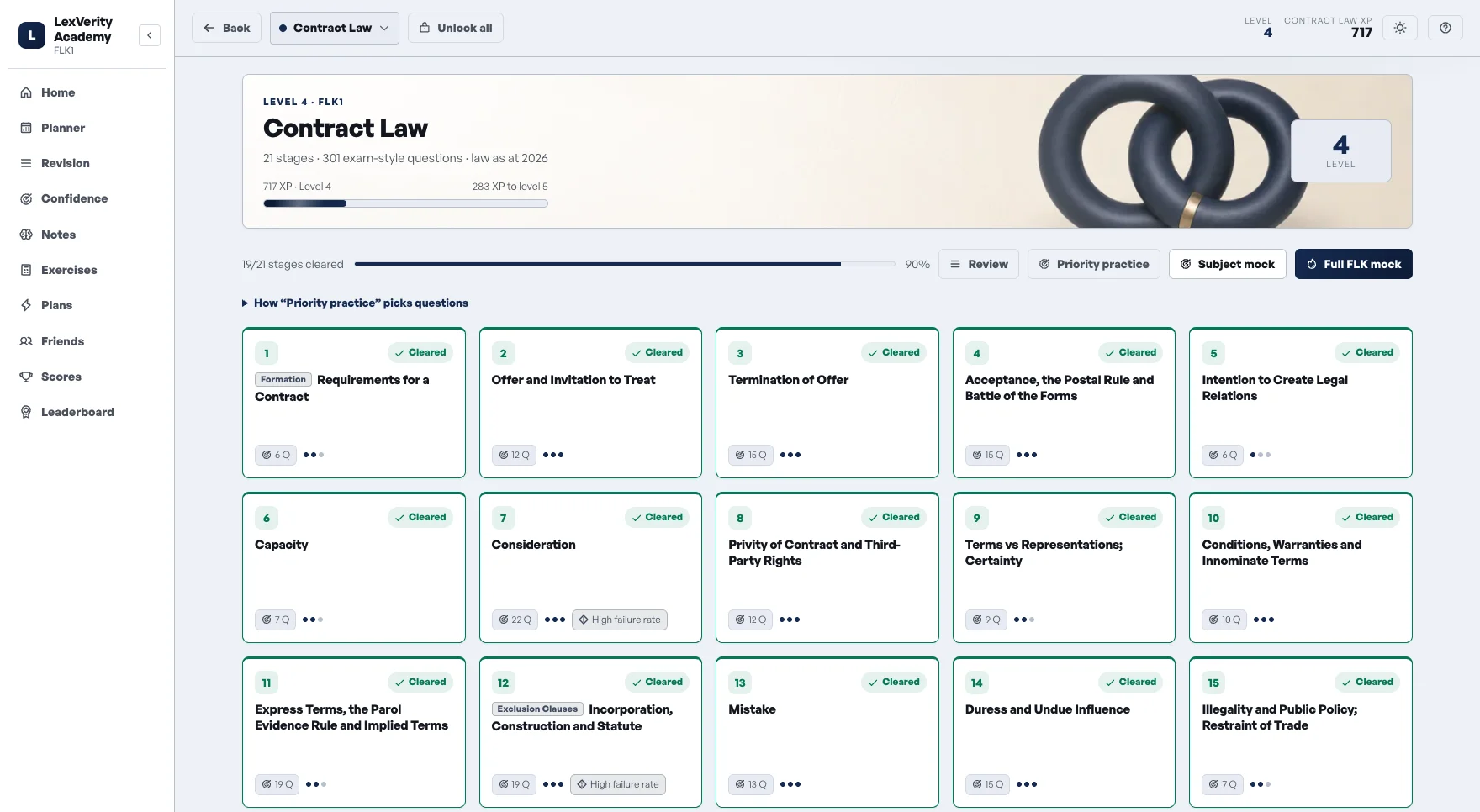
Every syllabus point, written to be learned
Every syllabus point across both papers, written to be learned rather than skimmed, with the primary-source citation behind every rule and figure.
3,400+ cited questions
Single best answer questions in the SQE1 format. Five options, one correct answer, and a written explanation of why each distractor is wrong.
Mocks and mind-maps
Timed mock exams structured on the real SQE1 assessment (a half-length paper on Standard, the full-length paper on Premium), and a visual revision mind-map for every subject.
Why candidates choose this over the classroom-style providers
A factual, sourced comparison against BARBRI, QLTS School, BPP and the University of Law on price, format and what is included, so you can weigh this course against the alternatives before choosing.
A citation behind every question
None of the four providers compared states, on its own public page, whether individual questions carry a primary-source citation. Every question in this course does, with a written explanation for each wrong answer.
A subscription, not a course fee
BARBRI, QLTS School, BPP and the University of Law each charge one course fee, often with a deposit, before study begins. This course is a subscription instead, with no deposit and no minimum term.
What is consideration, and why does it matter?
Consideration is what each party gives up, or promises, in return for the other party's promise. Without it, an agreement is not normally an enforceable contract under English law. It remains a gratuitous promise, which equity and the common law generally decline to enforce.
Consideration does not need to be adequate, meaning the courts will not weigh up whether the bargain was a fair one. It does need to be sufficient, meaning it must have some recognisable value in the eyes of the law, even if that value is small. Past consideration, meanwhile, is generally no consideration at all. Something already done before a promise was made cannot normally be the price of that promise.
This is a sample explainer for illustration. The full course covers every exception and application examiners test, subject by subject.
Built for recall, not re-reading
Each subject includes a mind-map of its rules, tests and key dates. Below is a simplified sample. The maps included with a Standard or Premium account are built out to the full depth of the subject.
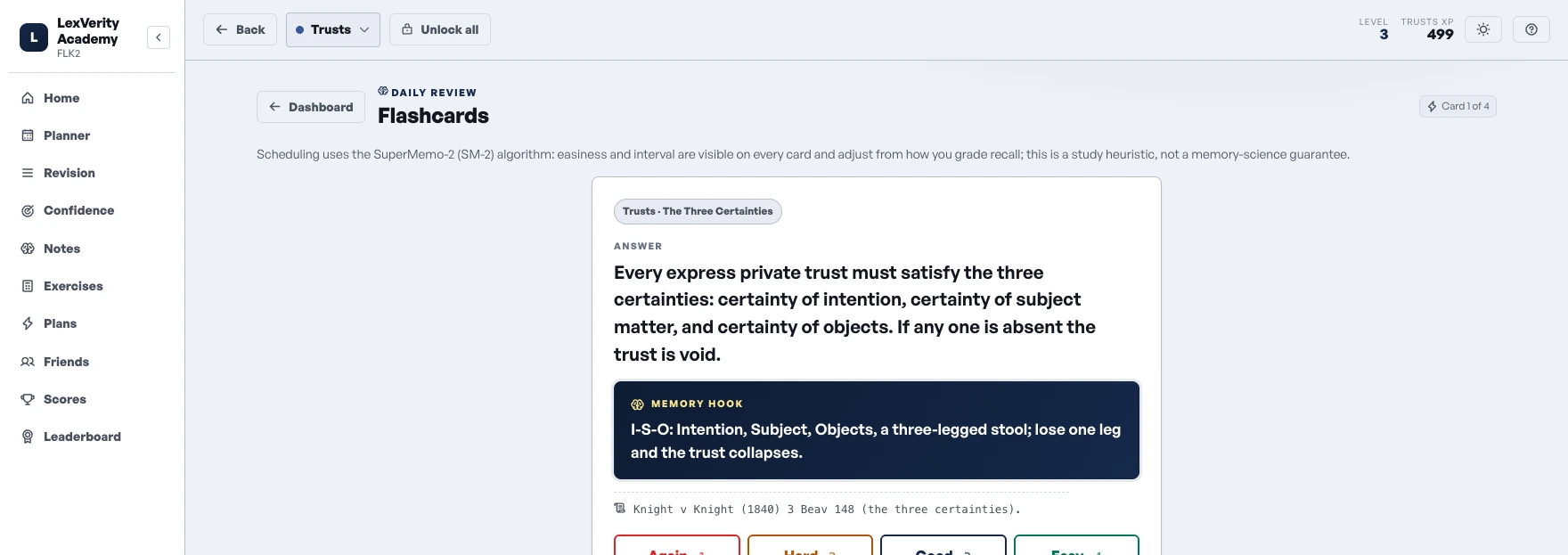
Spaced repetition, scheduled from the same cited content, not a separate deck.
The single best answer format
Every question in the course follows the same structure as the real assessment. One stem, five options, one correct answer, and a full explanation. The 3,400+ questions in a free or paid account are not shown here. The four below are written for this page only.
A retailer advertises that it will pay £50 to any customer who buys its multivitamin, takes it daily for three months as directed, and still catches a cold, adding that £5,000 has been placed in a separate account to meet valid claims. A customer buys the product, follows the instructions for three months, still catches a cold, and claims the £50 without ever contacting the retailer beforehand. Which of the following best describes the customer’s position?
An advertisement can be a unilateral offer to the world, capable of acceptance by anyone who performs the stipulated act, without any need to communicate acceptance in advance. Evidence of a genuine intention to be bound, such as money set aside to meet claims, displaces the argument that the advertisement was mere sales puff. Performing the stated act, buying and using the product as directed, is itself both the acceptance and the consideration, so no separate confirmation from the retailer is required.
Authority: Carlill v Carbolic Smoke Ball Co [1893] 1 QB 256.
A council carries out a statutory inspection of a footbridge but fails to notice a defect that a competent inspection would have found. The bridge later gives way, injuring a pedestrian. The council argues that, even applying the modern approach to a novel duty of care, no duty arises on these facts. Which combination of elements must the pedestrian establish to show that a duty of care existed?
Whether a duty of care exists in a novel situation is assessed using the three-stage test: foreseeability of harm, proximity between the parties, and whether it is fair, just and reasonable to impose a duty. The second option describes the standard for breach, not duty. The third describes causation and remoteness, only relevant once a duty and its breach are established. The fourth assumes a contractual relationship not present on these facts, and the fifth applies an unreasonableness-style test that has no role in an ordinary negligence claim.
Authority: Caparo Industries plc v Dickman [1990] 2 AC 605.
A will states: "It is my wish that my trustees allow my son to benefit from my collection of paintings as they see fit, and my daughter is to receive the remainder of my estate." Which certainty is most clearly missing in relation to the gift to the son?
Precatory words, expressions of hope or wish rather than obligation such as "it is my wish", point to a failure of certainty of intention: the settlor has not shown a binding intention to impose a trust rather than a moral request. Wide trustee discretion is not itself a problem, since discretionary trusts are valid, so the fourth option misdiagnoses the defect. The paintings and the residue are each sufficiently identified as assets, so subject matter is not what fails here, and nothing on the facts casts genuine doubt on the son’s identity.
Authority: Knight v Knight (1840) 3 Beav 148, and Re Adams and the Kensington Vestry (1884) 27 Ch D 394 (precatory words).
A defendant sets fire to a house to destroy insured contents, believing everyone inside has already left. In fact a resident is still asleep upstairs and dies in the fire. At trial, the defendant genuinely believed the house was empty, though a reasonable person in his position would have realised there was a high probability someone remained. Can the jury find that the defendant intended to kill?
The jury may find intention only where death or serious injury was a virtually certain result of the defendant’s act and the defendant himself appreciated that it was virtually certain, not merely where an objective, reasonable person would have foreseen a risk. Since the defendant genuinely believed the house was empty, the necessary subjective foresight is missing, so intention cannot be found on this route. Foresight of a high probability, short of virtual certainty, is not treated as legally equivalent to intention, and while motive is indeed irrelevant to whether intention exists, that principle does not itself supply the missing foresight.
Authority: R v Woollin [1999] 1 AC 82.
See the rest of the question bank
A free account unlocks the first section of every subject, including its full set of questions for that section.
Create a free accountQuestions about the course
Is FLK1 sold separately from FLK2?
No. LexVerity Academy is one SQE1 course covering both FLK1 and FLK2 in a single account. The FLK1 and FLK2 pages describe what each paper covers, but there is nothing extra to buy for either.
How many questions are in the question bank?
The course currently contains 3,400+ single best answer questions across all 13 FLK1 and FLK2 subjects, each with a primary-source citation and a written explanation.
What format are the questions in?
Every question is single best answer: one scenario, five options, and one correct answer, matching the format used in the real SQE1 assessment.
Can I try the course before paying?
Yes. A free account unlocks the first section of every one of the 13 subjects, including its question bank, with no card required. Revision maps are a Standard and Premium feature.
Are mock exams included?
Yes, from Standard. Standard includes the 90-question half-length mock; Premium adds the full 180-question paper structured on the SQE1 format.
Is this course written or checked using artificial intelligence?
Content is prepared using artificial intelligence to extract and structure the underlying law, then checked and reviewed by a legally qualified professional before it is published. The person who writes a page does not mark it as finished; see the disclaimer page for the full explanation.
How does this course compare with BARBRI, BPP, the University of Law or other SQE1 providers?
The SQE1 course comparison page sets out price, format and what is included for LexVerity Academy alongside BARBRI, QLTS School, BPP and the University of Law, with every figure for another provider sourced to that provider's own public page.
Does this course cover Qualifying Work Experience (QWE)?
No. QWE is a separate SRA requirement, not part of this or any prep course: broadly, at least two years of full-time equivalent legal work across up to four organisations, paid or unpaid, signed off by a solicitor or a Compliance Officer for Legal Practice. It can be completed before, during or after your SQE assessments; check the SRA's current guidance before relying on the detail.